The morning sun filtered through the bamboo slats of the small hut where Old Widow Rahma lived alone. Her days were simple: tending to her tiny garden, weaving old scraps into mats, and whispering prayers into the quiet breeze that drifted down from the hills. She had lived in this village for nearly seventy years, long enough for people to call her Nenek, grandmother, even if she had no surviving children of her own.
That particular morning, as she stepped outside with her wooden walking stick, she heard an unfamiliar sound: thin, trembling cries, barely louder than the flapping of a sparrow’s wings. At first, she thought it was a wounded bird. But when the sound came again—higher, more desperate—she followed it toward the back of her hut. There, beneath a fallen banana leaf, she found them.
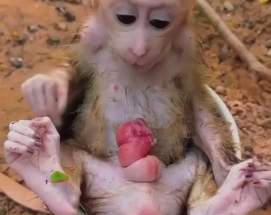
Two newborn monkeys. Twins. So small they looked like miniature dolls carved from warm clay. Their eyes were half-shut, their limbs soft and weak. One lay atop the other, seeking warmth; both trembled in the morning chill. Rahma gasped softly, placing a wrinkled hand to her mouth.
“Oh, little ones… what misfortune brought you here?”
She glanced around for any sign of a mother monkey. The forest border lay just a short distance away, but it was silent. No rustling leaves. No troop calls. No frantic mother searching the ground. Nothing at all. Whatever had happened to the troop, or these babies’ mother, the little ones were alone now—alone and too young to survive on their own.
Rahma knew enough about wildlife to understand danger. Newborn monkeys needed warmth, constant feeding, and protection. She also knew something else: she had nothing to give. No milk, no formula, not even leftover broth. Her pantry held only rice, dried herbs, and a handful of sweet potatoes she was saving for the week. Still, she could not leave the babies outside.
She wrapped them gently in the ends of her shawl and brought them inside. Their tiny fingers grasped the fabric weakly. One of them—whom she later named Lumo—let out a faint squeak that tugged at her heart. The other, Lani, simply nestled closer, too exhausted even to cry.
“I have no milk for you,” Rahma whispered as she sat near her hearth. “But I will find help. You will not be alone.”
She lit a small fire and warmed the room, placing the twins near the heat but not too close. She lined a woven basket with the softest scraps she had. The babies curled into the warmth, their trembling easing slightly. It wasn’t enough, but it was what she could offer in the moment.
Rahma thought of her neighbors, but most of them worked in the fields until dusk. The closest wildlife center was too far to walk to—at least for someone with her aching knees. She needed someone who could move quickly. Her mind settled on one name: Jaya, a young man known for assisting with injured animals and forest rescues. His home was a fifteen-minute walk away, but for Rahma, that distance felt like miles.
Still, she rose, pulling her shawl tightly around her shoulders. She placed the basket near the hearth. “Stay warm, little hearts. I will return.”
Her legs protested every step, yet she pushed forward, moving slowly along the dirt path. She had no children to carry her burdens, no relatives to lean on, but she carried determination like a torch. By the time she reached Jaya’s house, her breath was thin, but she knocked firmly.
Jaya opened the door, startled to see her. “Nenek Rahma? What happened?”
She told him everything in a single breath: the cries, the abandoned twins, her empty pantry, her fear that they would not survive another hour without care. Without hesitation, Jaya grabbed his rescue pack.
“Come,” he said. “Show me.”
Back at the hut, the twins were still alive, but their cries had grown weaker. Jaya examined them gently. “They’re newborns—very young. They need warmth and proper formula. But they still have strength. With quick care, they have a good chance.”
Rahma’s eyes filled with relief. “Please help them, Jaya. I have no milk. I have nothing.”
“You have already done something,” he said warmly. “You saved them from the cold.”
Jaya mixed emergency formula from his kit and fed them drop by drop. Lumo accepted the feeding quickly, gripping Jaya’s finger with surprising determination. Lani hesitated, eyes barely opening, but after a few moments, she too began drinking faintly. Rahma watched with trembling hope.
“Will they live?” she asked softly.
“They will if we keep this up,” Jaya replied. “We should take them to the rehabilitation center tomorrow, but for tonight, they can stay here with us. Between the two of us, we can keep them warm and fed.”
Rahma’s voice wavered. “I will stay up with them all night if I must.”
Together, they created a warm corner near the hearth for the babies. Rahma hummed old lullabies as she watched them sleep—songs she used to sing long ago, before loss took her family from her. Now, the gentle notes returned to her lips, fragile but full of meaning.
Throughout the night, Rahma and Jaya took shifts feeding the babies. With each feeding, the twins grew a little stronger. Lumo began stretching his fingers, and Lani pressed her face into Rahma’s palm, seeking warmth. The bond forming between the old widow and the orphaned twins surprised even her. She felt something awaken inside—a tenderness she thought time had taken away.
By dawn, when Jaya returned with transportation to the wildlife center, Rahma lifted the twins one last time. “Live well, little ones,” she whispered. “Grow strong.”
Jaya smiled. “They will remember your warmth.”
As the twins were carried toward their new home, Rahma stood outside her hut, the morning breeze cooling her cheeks. She had no milk, no wealth, and no family left—but she had given the twins what she did have: love, warmth, and the courage to act.