The sun had barely risen over the tops of the tall banyan trees when the peaceful quiet of the forest’s edge was shattered by a pair of thin, trembling cries. The cries didn’t sound like birds or insects or even the usual chatter of monkeys—they were softer, more frantic, full of desperation. Anyone walking nearby would have mistaken them for the sounds of frightened babies.
And in a way, they were.
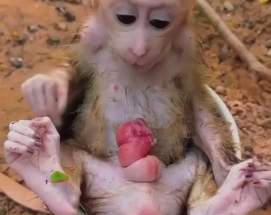
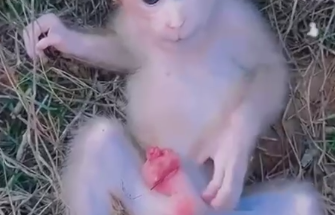
Two newborn twin monkeys lay curled inside a nest of dried leaves near the edge of a footpath. Their fur was still patchy, their eyes only half-open, their limbs wobbly and weak. They had survived the cold night only because they had clung tightly to each other, but morning brought a new problem: hunger.
And hunger brought tantrums.
Little Lito, the slightly bigger twin, cried first—a high, wavering squeal that echoed into the trees. Lila, the smaller one, followed a second later, her cry softer but just as desperate. Their tiny bellies were empty, and the warm comfort of their mother’s milk had been missing for hours. They didn’t understand why she had not returned. They only knew that the ache inside them grew sharper by the minute.
The twins kicked their legs weakly, their arms reaching out in instinctive movements, searching for their mother’s chest, her warmth, her heartbeat—anything familiar. But there was nothing except the rustling leaves beneath them.
Their crying grew louder.
And that was when Maya heard them.
Maya, a young woman who had lived near the forest since childhood, had spent many mornings gathering herbs for her grandmother. She had learned to recognize the sounds of every animal living nearby. But today’s cries were different—too helpless, too raw, too young.
She followed the sounds quickly, heart pounding, until she spotted the tiny pair among the leaves.
“Oh no…” she whispered. “Babies. Newborns.”
Her heart tightened at the sight. She knelt beside them, moving slowly so as not to frighten them. But the twins were already crying too desperately to care who approached.
Lito flailed his arms and legs in tiny bursts, his face scrunched with frustration. Lila squirmed and kicked, letting out her own trembling tantrum of hunger. Both reached toward Maya’s shadow as though hoping she might magically turn into their missing mother.
“It’s okay, little ones,” Maya murmured. “I hear you. Don’t worry.”
But newborn monkeys couldn’t survive long without milk. They needed warmth, feeding, and constant care. Maya knew she had to move quickly.
She lifted them gently, one by one, cradling them close to her chest. They were so small—lighter than the herbs she carried, softer than cotton—and they trembled against her palms. Lito buried his face against her shirt immediately, nuzzling as if begging for food. Lila was weaker, her tiny breaths uneven, but she clung to Maya’s fingers with surprising determination.
“You’re hungry,” Maya said softly. “I know. Let’s get you home.”
She hurried down the narrow dirt path toward her cottage, careful to shield the twins from the morning breeze. With every step, their cries echoed through the quiet trees. Lito threw his head back, protesting loudly. Lila whimpered, her voice fragile but persistent. Their tiny tantrums seemed endless, as though they feared the world had forgotten them.
When Maya finally reached home, her grandmother, Asha, looked up from her weaving.
“What is that sound?” Asha asked, startled.
Maya opened her shawl. “Twin newborn monkeys. Abandoned. They need milk fast.”
Asha gasped softly, rising to her feet. “Oh dear spirits… Bring them to the hearth.”
The two women moved quickly. Asha warmed a soft blanket near the fire while Maya mixed emergency formula from a small kit she kept for rescued animals. She added warm water, stirring carefully until it reached the right temperature.
Meanwhile, the twins continued crying—now louder than before. Lito squirmed so much that Maya had to hold him securely. Lila trembled in the blanket, her lips twitching in hunger.
“They’re throwing tantrums,” Maya said breathlessly. “They must be starving.”
Asha chuckled softly. “Tantrums mean life. Weak ones don’t cry. Feed them.”
Maya lifted Lila first, supporting her tiny head, and touched the warm syringe to her lips. For a moment, the newborn resisted—too tired, too hungry, too confused. Then her instinct awakened, and she latched onto the drop of milk.
“Oh… good girl,” Maya whispered.
Lila drank slowly at first, then with growing eagerness. Her tantrum quieted. Her trembling eased. Her tiny fingers curled gently around Maya’s thumb.
Lito, however, had other plans.
When Maya tried to feed him, he threw another miniature tantrum—kicking his legs, squealing, trying to latch onto her shirt instead of the syringe. His little face wrinkled in frustration.
“Hey, hey,” Maya soothed, laughing softly despite the worry. “Your sister figured it out. You can do it too.”
She tried again. Lito turned his head away dramatically, squeaking loudly. Asha shook her head.
“He’s strong,” Asha said. “But strong ones can be stubborn.”
Maya took a calming breath and held Lito closer to her chest, letting him hear her heartbeat. Slowly, his cries softened. When she offered the syringe again, he sniffed it, squeaked once in protest, and finally latched on.
“That’s it,” Maya whispered. “Good boy.”
Milk dripped onto his tongue. His eyes closed halfway. His tantrum melted into peaceful sucking.
Soon, both Lila and Lito were fed, warm, and wrapped snugly in the soft blanket. They curled together instinctively, their earlier frustration replaced by contentment. Lito pressed his face against Lila’s shoulder. Lila stretched her tiny arm over him protectively.
Maya watched them with a tender smile. “They just wanted milk… and love.”
Asha nodded. “All babies do.”
As the twins drifted into sleep, Maya placed them inside a small basket lined with fleece. Their breathing synchronized—tiny, steady, full of the life they had fought for only an hour earlier through tears and tantrums.
“They’re safe now,” Maya whispered. “And tomorrow, we’ll take you both to the wildlife center. But tonight… you’re home.”
The room fell quiet again, filled only with the soft sound of two tiny survivors sleeping side by side.
In their new home, with full bellies and warm hearts, the tantrums were over—at least for now