The morning sun had barely risen when Liana Torres, a seasoned wildlife rehabilitator, stepped onto her porch after hearing the soft rumble of a delivery vehicle pulling away. She didn’t expect any packages that day, certainly not one large enough to occupy half her doorstep, labeled with bright red stickers reading “FRAGILE – LIVE RESCUE.” Her heart tightened instantly. Whenever a crate arrived unexpectedly, it meant something vulnerable needed help—and quickly.
2.
Liana crouched down, pressing her ear gently against the side of the crate. At first, she heard nothing but the faint hum of the warming pads inside. Then a sound emerged—a thin, trembling squeak, so soft she wondered if she had imagined it. Another followed, slightly louder this time. Two tiny cries. Her chest tightened. “Twins,” she whispered. It wasn’t common for newborn monkeys to be found alive together, especially in such fragile condition.
3.
She carried the crate to her indoor rehabilitation room, her arms steady despite the rush of concern flooding her. The box felt unexpectedly light, emphasizing just how tiny the infants inside must be. With practiced calm, she sanitized her hands, set up her recording equipment for official documentation, and slowly unlatched the front panel. Warm air drifted out, scented with soft cloth and formula. What she saw next was both heartbreaking and hopeful all at once.
4.
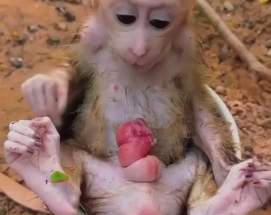
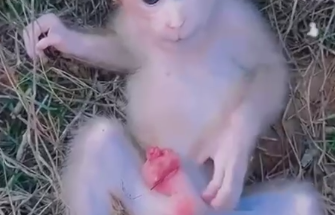
Two newborn monkeys, curled tightly around each other, lay nestled in heated blankets. Their skin carried the pinkish tone typical of incredibly young infants, and their limbs were thin and trembling. The twins’ fingers twitched faintly, always reaching toward each other as though confirming the other was still there. One had slightly darker fur developing along his spine; the other had a small swirl of pale fur near her forehead. Liana named them Milo and Mira.
5.
Their story, according to the brief note taped to the crate, began the previous night. Forestry officers conducting a sweep near an abandoned illegal campsite found the infants alone beside a smoldering fire pit. No adult monkeys were anywhere nearby. No troop sounds. No nesting site. Nothing. Whether their troop had been frightened off, separated, or worse, no one knew. Newborns this young could not survive even a few hours without warmth and feeding.
6.
Liana lifted Milo first, supporting his head the way one would support a human newborn. His skin felt cool, his breaths shallow but steady. Mira was even lighter, so delicate that Liana paused just to feel the tiny rise and fall of her chest. “You two are fighters,” she whispered. She moved them carefully to the neonatal incubator, pre-warmed to mimic the temperature of a mother’s embrace. The twins reacted instantly, their fingers curling around the soft surrogate cloth placed beside them.
7.
Feeding them would be the next challenge. Newborn primates required slow, precise feeding to prevent aspiration. Liana warmed a small syringe of formula, testing the temperature on her wrist. Milo responded first, instinctively nuzzling the tip, his tiny mouth trying to latch. Mira took longer. She resisted, weak and unsure, but with gentle encouragement—soft strokes along her cheek and steady warmth—she finally accepted her first droplets of nourishment.
8.
Minutes later, a slight but unmistakable change filled the room: the twins’ trembling eased. Their breathing deepened. Milo curled his toes against the fabric, while Mira rested her head on his chest. The transformation wasn’t dramatic, but it was significant. In wildlife rescue, victories often came in small, fragile steps—steady warmth, an accepted feeding, a slowing heartbeat returning to normal. Liana allowed herself a moment of relief.
9.
Throughout the morning, she monitored their vitals, recorded their reactions, and adjusted their environment. She added a gentle heartbeat sound to simulate maternal presence, dimmed the lights to avoid overstimulation, and ensured the cloth surrogate remained securely in place. The twins rarely separated from each other. Even in sleep, Milo’s foot would brush against Mira’s, and Mira’s hand would curl around Milo’s arm. Their instinctive bond was unmistakable and comforting.
10.
By midday, Liana contacted the forestry officers for any updates. None had returned to the site yet, but they planned additional sweeps to search for signs of the troop. Liana knew the odds were slim. Troops on the move rarely backtracked long distances, especially with signs of human disturbance. Still, she welcomed the attempt. Her ultimate goal was always reunification, though in cases like this, rehabilitation was often the only viable path.
11.
When she posted her official intake update—educational, factual, and gentle—the community responded immediately. Comments poured in from local followers who had grown familiar with her rescue work. “Poor babies,” one wrote. “Please keep us updated.” Another said, “Thank you for caring for them. They deserve a chance.” Liana appreciated the support, but more importantly, she hoped stories like this encouraged people to understand—really understand—how fragile wildlife populations were becoming.
12.
As evening settled in, she gave the twins their second feeding. Milo drank steadily, stronger than before. Mira still required patience, but her grip had noticeably improved; she held Liana’s finger with a strength entirely disproportionate to her size. After feeding, the twins drifted into a deeper sleep than they had managed earlier, their bodies warm, relaxed, and gently rising against the steady glow of the incubator.
13.
Before dimming the lights, Liana stood watching them—two tiny lives who had arrived unexpectedly, carried in a crate that symbolized both tragedy and hope. There was a long journey ahead: night feedings, gradual strengthening, socialization with other young monkeys, and eventually preparing them for life beyond her home. But for now, in this quiet room, the twins rested safely, their bond unbroken, their future finally possible.