In the soft light of early morning, when the mist still lingers above the tree line and the lake’s surface resembles a sheet of untouched glass, the last thing anyone expects to find is a lone newborn monkey struggling for survival. Yet that was exactly what happened near the edges of Sadera Forest, a region known not only for its wildlife diversity but also for its delicate balance between human expansion and natural habitat.
The discovery has since spread rapidly across local communities and online platforms, capturing hearts and prompting widespread conversations about animal protection, habitat encroachment, and the quiet tragedies that unfold unseen in the forest each day.
A Shocking Sight by the Water’s Edge
The story begins with Arun Patel, a fisherman who often arrives at the lake before dawn. His routine was simple: cast nets, wait, and enjoy the silence only nature can offer. But that morning, the silence held something different—soft, uneven sounds, like tiny gasps.
As Arun walked closer to the shallows, he spotted a lump of fur barely moving against the pebble-strewn shoreline. At first, he thought it was debris. Then the small form shifted—weakly but unmistakably alive.
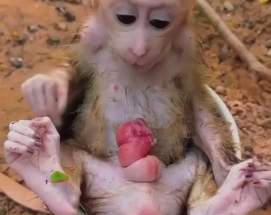
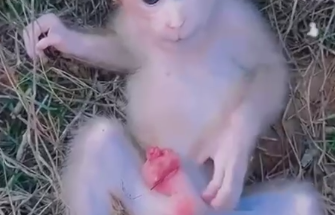
It was a newborn monkey, no more than a few days old, still with the pinkish hue of infancy and the fragile, curled limbs characteristic of a creature newly introduced to the world.
“I couldn’t believe it,” Arun later shared. “Such a tiny thing, all alone by the water. It must have been terrified. I knew right away it needed help.”
There were no adult monkeys in sight, no troop calling from the trees, no mother frantically searching for her lost baby. Instead, the little primate lay trembling, soaked, and exhausted.
How Did the Baby End Up There?
Wildlife officials who later examined the area offered several theories. Baby monkeys are highly dependent on their mothers, who keep them clinging to their bodies almost constantly during the first months of life. A newborn separated from its mother is extraordinarily rare under natural circumstances.
Some experts believe the infant may have been accidentally dropped by a first-time mother navigating tree branches near the lake. Others suspect a disruptive encounter—perhaps a predator scare or territorial dispute among monkey troops—that caused the mother to flee or drop the baby during the chaos.
More troubling, however, is the possibility of human interference. In some regions, infant monkeys become targets for illegal wildlife trade. Authorities have not ruled out the idea that someone might have taken the baby from its troop and later abandoned it when they realized how difficult caring for such a fragile creature would be.
Regardless of the cause, one thing is certain: the baby would not have survived much longer without intervention.
A Race Against Time
Arun carefully wrapped the infant in his scarf and rushed to the nearest wildlife rehabilitation center, located about twenty minutes away by motorbike. Every second mattered; newborn monkeys cannot regulate their body temperature well and require constant warmth, feeding, and contact.
At the center, veterinarians immediately got to work. The baby was dehydrated, chilled, and extremely weak, but responsive. They named him Chotu, meaning “little one.”
The staff placed Chotu in an incubator specifically designed for abandoned or injured young wildlife. They administered warmed fluids, gently cleaned him, and monitored his breathing. Throughout the day, the tiny monkey clung to a soft cloth surrogate—an essential tool used to mimic maternal touch and reduce stress.
Dr. Kavira Sen, the head veterinarian, expressed cautious optimism. “Chotu has a long road ahead. Newborn primates require round-the-clock care, and the first 48 hours are critical. But he’s fighting. And sometimes that’s enough for us to work with.”
Community Response and Viral Attention
Word of the rescue spread quickly. Arun’s initial photos—showing the small, fragile bundle wrapped against his chest—went viral on social media, with thousands reacting to the emotional discovery.
Local schools used Chotu’s story to teach children about wildlife conservation. Environmental groups seized the moment to emphasize the increasing impact of human settlements on forest ecosystems. Volunteers flooded the rehabilitation center with offers to donate supplies, blankets, or funds.
But the biggest impact came from the awareness raised about animal abandonment, whether accidental or intentional. Many people admitted they had never considered how vulnerable newborn monkeys are, especially in regions where natural habitat is shrinking.
“This story touched people because it reminds us that nature is not separate from our lives,” said environmentalist Mara Ghosh. “Behind every tree cut down, every path cleared, there are animals whose lives are altered. Chotu is just one example we happened to find.”
Healing and Hope
Over the next few weeks, Chotu’s condition slowly improved. His eyes opened fully, revealing bright, inquisitive glances at the world around him. He began to grip sticks, cloth, and the fingers of his caretakers with increasing strength. Every small milestone was celebrated by the staff.
Feeding became more regular, and soon the newborn’s tiny squeaks grew more confident. The goal, though, was not to raise Chotu as a captive but to eventually reintroduce him to a troop capable of accepting an orphan.
Young monkeys rely not only on maternal care but also on the social structure of a troop to learn essential survival skills. Integrating an orphan is delicate work, requiring gradual introductions and careful observation. The rehabilitation center has successfully integrated monkeys in the past, but every case is unique.
“We move slowly,” Dr. Sen explained. “First, Chotu must gain strength. Then he’ll socialize with other young monkeys here, building confidence. Only when he’s ready will we attempt to introduce him to a wild troop.”
A Story Bigger Than One Baby Monkey
While Chotu’s rescue is a beautiful example of compassion, it also highlights much larger issues: habitat destruction, illegal wildlife trading, and the fragile line between human expansion and natural ecosystems.
Environmental groups are urging local officials to strengthen protections around Sadera Forest, including better monitoring of wildlife corridors and stricter enforcement against poaching.
Arun, now considered a local hero, insists he only did what any person should do when faced with a life in danger. Yet his decision, made in a split second on a quiet morning, has rippled through his community and beyond.
“When you see a living being suffering,” he said, “you help. That’s all.”
A Symbol of Resilience
As of now, Chotu continues to grow stronger under the warm, watchful eyes of his caretakers. His future, once uncertain, now carries a hopeful glow.
And the lake near Sadera Forest—once the unlikely stage for a newborn’s struggle—now stands as a symbol of attentiveness and the profound impact of human compassion.